

Solutions
keyboard_arrow_downServices
keyboard_arrow_downSupport & Resources
keyboard_arrow_downCompany
keyboard_arrow_downContact

Benefits of the Randox sdLDL-C Assay
Superior method
The clearance method produces results in as little as ten minutes, facilitating faster patient diagnosis and treatment plan implementation. The previous methods, ultracentrifugation and electrophoresis, were laborious and time consuming.
Exceptional correlation
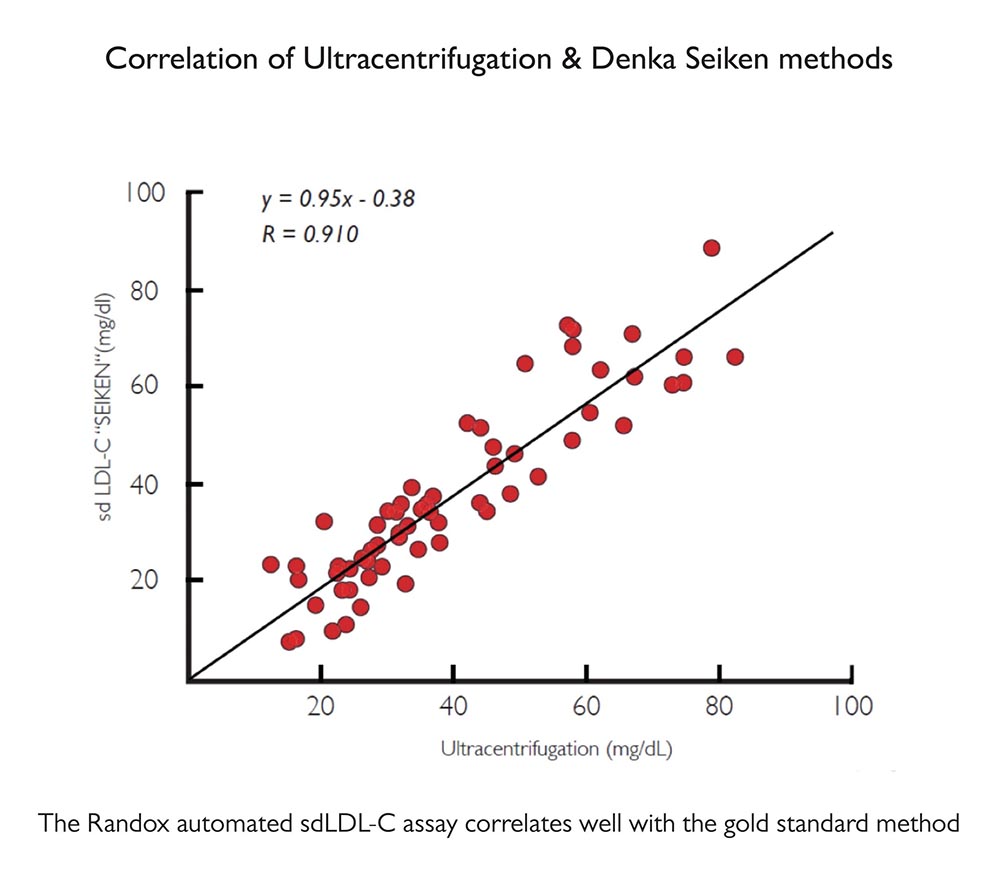
A correlation coefficient of r=0.91 was displayed when the Randox methodology was compared against the gold standard method, ultracentrifugation.
Liquid ready-to-use assay
The Randox sdLDL-C assay is available in a liquid ready-to-use format for convenience and ease-of-use.
Dedicated calibrator and control available
Dedicated sdLDL-C calibrator and control available offering a complete testing package.
Applications available
Applications are available detailing instrument-specific settings for the convenient use of the Randox sdLDL-C assay on a wide range of clinical chemistry analysers.
Ordering information
| Cat No | Size | |
|---|---|---|
| 562616 | R1 1 x 19.8ml (L) R2 1 x 8.6ml | Enquire Kit Inserts RequestsView MSDSBuy Online |
| 562760 (U) | R1 1 x 18ml R2 1 x 7ml | Enquire Kit Inserts RequestsView MSDSBuy Online |
| 562791 *(U) | R1 5 x 200ml | Enquire Kit Inserts RequestsView MSDSBuy Online |
| 562807 *(U) | R2 2 x 200ml | Enquire Kit Inserts RequestsView MSDSBuy Online |
(L) Indicates a liquid reagent
(U) Indicates for use in the USA only
(*) Indicates that boths kits must be purchased together
Instrument Specific Applications (ISA's) are available for a wide range of biochemistry analysers. Contact us to enquire about your specific analyser.
Diagnostic Uses
Physiological Significance
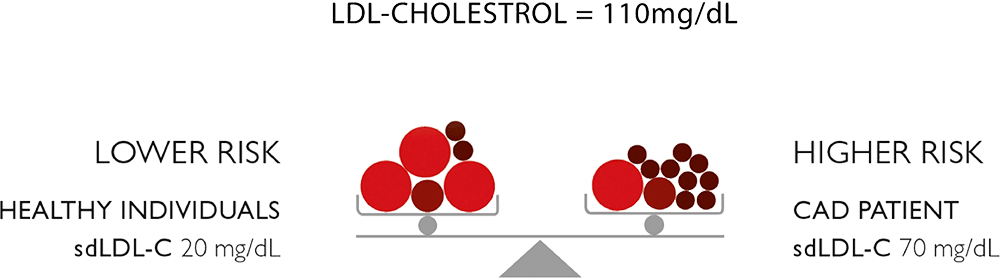
When measuring LDL cholesterol (LDL-C), it is the cholesterol mass within the LDL particles that is being measured. The LDL particle population within LDL is heterogeneous – meaning that the size, density & composition of each particle will be different. sdLDL-C is a subfraction of low density lipoprotein (LDL) with smaller particle size and higher density than larger more buoyant LDL. They all transport triglycerides and cholesterol to the tissues, but their atherogenesis varies according to their size. sdLDL-C will more readily permeate the inner arterial wall. sdLDL-C is more susceptible to oxidation and has a lower affinity to the hepatic LDL receptor, and as such circulates in the blood longer 1.
Risk Assessment
As sdLDL-C is particularly atherogenic, a person with elevated sdLDL-C levels has a 3-fold increased risk of myocardial infarction (MI)2.
sdLDL-C measurement therefore provides a more comprehensive understanding of cardiovascular disease (CVD) risk compared to traditional LDL-C tests.
Management
Reducing sdLDL-C levels will aid in reducing the risk of CVD and MI. High dose statin therapy has been proven to aid in reducing the levels of sdLDL-C as a risk factor for cardiovascular events and high risk patients. Elevated levels of sdLDL-C arise from multiple sources. A major factor is a sedentary lifestyle with a diet high in saturated fat. Insulin resistance and pre-diabetes have also been implicated, in addition to genetic predisposition 3.
The measurement of LDL-C or the review of levels within arteriosclerotic coronary heart disease (ASCHD) treatment are known within different guidelines (including ATP III, AHA/ ACC, ESC/ EAS and NICE). However doubt remains on the impact of targeting LDL-C only. The inclusion of sdLDL-C within the clinical testing panel will assist in removing this doubt.
Methods of Detection
The Randox sdLDL-C test is a direct method for the quantitative determination of sdLDL-C using a range of chemistry analysers capable of accommodating two-reagent assays. The assay consists of two steps and is based on the use of well-characterised surfactants and enzymes that selectively react with certain groups of lipoproteins.
Get in touch to discover more
To find out more about Small Dense LDL Cholesterol (sdLDL-C) and other diagnostic reagents, enquire now.